At WOOLTON & HEWITT, our wedding and engagement rings are
crafted using carefully selected precious metals, including a
range of gold alloys, platinum 950, and palladium 950. Each offers
its own unique character and beauty. Understanding these
differences will help you choose the metal that best suits your
style, lifestyle, and expectations. Let’s explore them in more
detail.
 Precious Metals
The precious metal at the heart of a ring shapes its beauty,
colour and character. Each metal has its own qualities, making it
an important part of choosing a ring that will be worn for a
lifetime.

Gold | Au
Gold has been valued for thousands of years for its rarity and
beauty. It can be shaped into intricate forms and, when polished,
display a naturally rich and silky lustre. Gold is the classic
precious metal for wedding and engagement rings.

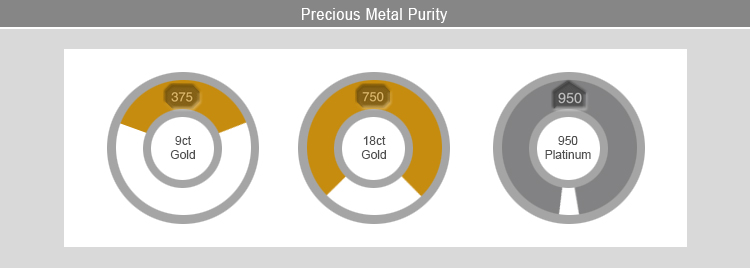
Gold purity is measured in carats (ct or k), with 24 carat gold
representing pure gold. Pure gold is naturally very soft, so it is
alloyed with other metals to increase strength and durability. The
grades of gold commonly used in jewellery are:
9ct - 37.5% gold | 14ct - 58.5% gold | 18ct - 75% gold | 22ct -
91.6% gold
At WOOLTON & HEWITT we work with gold in a variety of colours
of gold, including:
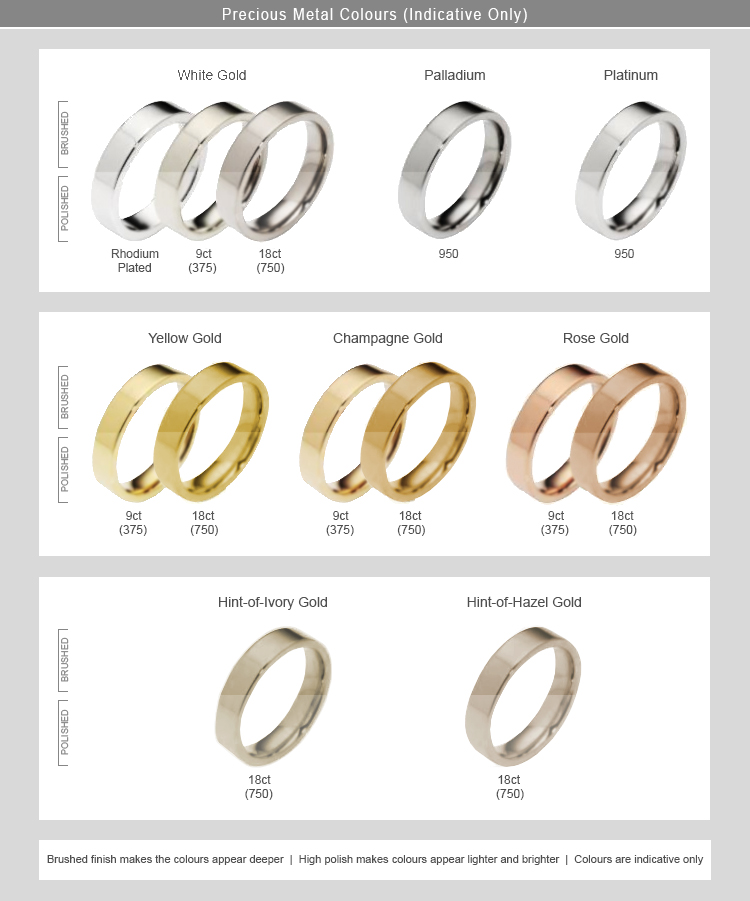
Yellow gold | White gold | Rose gold | Champagne gold |
Hint-of-hazel gold | Hint-of-ivory gold
These colours are created by mixing gold with other metals. White
gold, for example, is created by alloying gold with metals such as
silver and palladium. Rose gold contains a higher proportion of
copper, which produces its warm reddish tone. Champagne gold sits
between rose and yellow gold and is reminiscent of colours found
in Victorian jewellery. Hint-of-hazel gold and hint-of-ivory gold
are subtle variations of white gold with slight brown or warm
yellow undertones.
White gold is not naturally pure white in colour, so it is often
rhodium plated to create a bright white finish. Over time this
plating will gradually wear away, revealing the underlying colour
of the alloy beneath. The ring can be re-plated if desired,
although many people enjoy the natural patina that develops with
age.
Platinum | Pt
The ultimate precious metal for wedding rings, platinum is the
rarest used in jewellery and is prized for its durability, purity,
and natural white colour.

It belongs to the Platinum Group Metals, a family of closely
related metals including palladium, rhodium, ruthenium, iridium,
and osmium. Platinum has a naturally bright silvery-white
appearance, very high density, and excellent resistance to
corrosion. It also has the highest melting point of all precious
metals which contributes to its durability and prestige.
There are lower grades, but at WOOLTON & HEWITT, we only use
platinum 950 which is the highest quality for fine jewellery.
Because of the high density of platinum 950, your rings will
generally feel heavier and more substantial than rings made from
gold or palladium.
Palladium | Pd
Palladium is a rare, naturally white precious metal closely
related to platinum. It is a fine precious metal for engagement
and wedding rings.

It is also part of the Platinum Group Metals, which includes
platinum, rhodium, ruthenium, iridium, and osmium. Palladium has
been used in jewellery for many years, but its popularity
increased significantly in the early 21st century. In the United
Kingdom, hallmarking of palladium jewellery became a legal
requirement from 1 January 2010. Recognised fineness standards
are:
500 | 950 | 999 (parts per thousand)
Palladium has a similar but greyer, appearance to platinum. It is
less dense, meaning a palladium ring will usually feel lighter on
the finger than platinum or 18ct gold.
WOOLTON & HEWITT can create your special wedding and
engagement rings in palladium 950 - that's the highest quality for
fine jewellery and is 95% pure (by contrast, palladium 500 is only
50% pure).
Colours of Gold
Gold is available in a wide range of colours and shades. The guide
below shows the main variations, although colours displayed on
screens can vary significantly from the real metal. For this
reason, photographs and images should be regarded as illustrative
rather than exact representations.
Durability
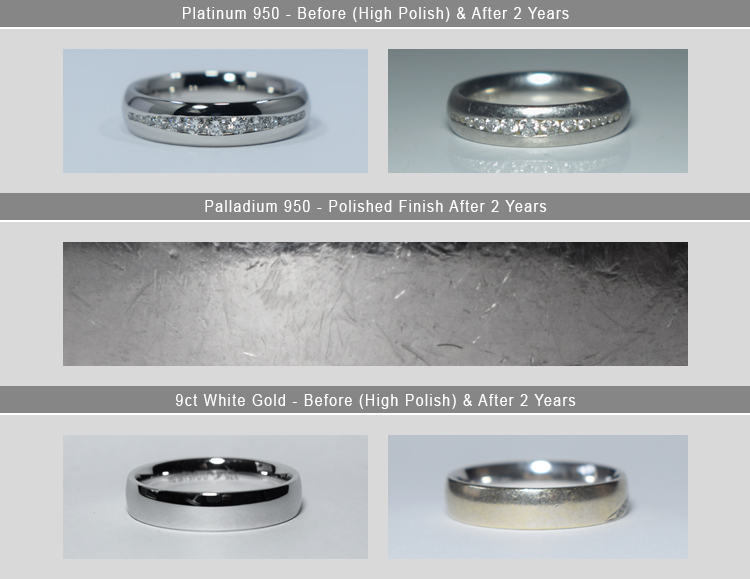
All precious metals used in jewellery are softer than materials
such as steel or ceramics. As a result, your rings will inevitably
come into contact with harder objects during everyday life - door
handles, taps, keys, coins, and many other surfaces. Over time
this normal wear will create scratches, dents, and small marks.
When rings are brand new these marks can be noticeable,
particularly when compared to the flawless finish of a newly
polished surface. However, as time passes the marks blend together
to form a natural patina, reflecting the life your rings have
shared with you. Although the properties of different precious
metals do vary, in practical everyday use all precious metal rings
will develop surface marks. This is normal and is simply part of
the story of your lives together.
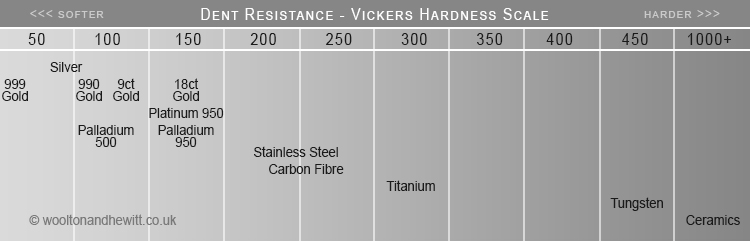
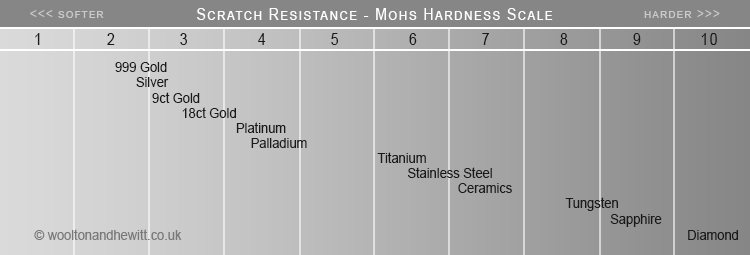
For those interested in the technical details, hardness can be
measured using different methods. The Vickers hardness test
measures resistance to indentation and is expressed in HV units.
The Mohs hardness scale compares the resistance of materials to
scratching.
Brushed vs Polished
When rings are new, a brushed finish may initially show marks more
clearly than a polished surface. This is because scratches
interrupt the otherwise consistent texture of the brushed pattern.
In contrast, the early marks on a high polished ring are often
less noticeable because reflections from the polished surface
disguise them.
As marks accumulate over the first weeks of use, for both brushed
and polished finishes, they will become clearly noticeable.
Focusing on them at this point can be worrisome. This is actually
just normal wear and tear for all precious metals exposed to the
everyday environment.
After about six to twelve months your rings will have integrated
all the various marks, scratches and dents into a patina that
reflects their "lived-in" status. At this point it can be quite
hard to tell which ring started out as brushed and which was
polished.
In the end, a brushed ring becomes marked and develops a partial
polish in some areas as a result of rubbing. And a polished ring
becomes similarly marked but looses it shine due to the
accumulation of a myriad of tiny scratches. Although they start
out looking quite different they start to appear quite similar.
Finally, after about two years of use, your rings will have taken
on their "mature" appearance gracefully ageing as you journey
through life together.
Allergies
Although rare, it is possible to be allergic to metals. Precious
metals are actually alloys combining various types of metal so if
you are, or suspect you may be, allergic to any type of metal
please contact us before ordering your rings.
Quality Assured
A hallmark, applied inside your ring, confirms the purity of the
precious metal used in its creation. In accordance with UK
hallmarking law, all WOOLTON & HEWITT wedding rings,
engagement rings, and jewellery are independently hallmarked by an
official UK Assay Office. This independent testing and marking of
precious metals provides your assurance of quality and
authenticity. For more details please see our Quality
Assured section.
Care
Your rings are precious symbols of your life together, so caring
for them properly is important. For guidance on cleaning and
caring for your engagement and wedding rings, please click
here.
Precious Metals and Sustainability
Precious metals such as gold, palladium and platinum are at the
heart of fine jewellery, but their sourcing can involve
environmental and social challenges. Because of this we work with
suppliers who follow responsible and ethical practices. All of our
partners comply with the Code of Practices of the Responsible
Jewellery Council, thus ensuring responsible sourcing and
transparent supply chains.
Responsible precious metal sourcing includes:
- Working with reputable and trusted precious metal suppliers
- Transparency and traceability in precious metal supply chains
- Responsible environmental practices in mining and refining
- Minimising environmental impacts
- Respect for labour rights and safe working conditions
- Prevention of child labour and forced labour in supply chains
Together, we aim to contribute to a more sustainable and
responsible jewellery industry that respects people, communities
and the environment.
Written by Paul - Founder
of WOOLTON & HEWITT and LGBTQ+ wedding jewellery specialist
Reviewed by the WOOLTON & HEWITT workshop and design teams







 Fine
Quality - beautifully made rings
Fine
Quality - beautifully made rings Expert Advice - chat things over with us
 Warranty - workmanship guaranteed
 Delivery - fast and insured
 Types
of precious metal
Types
of precious metal