Whether you’re choosing a classic
solitaire, a bold statement
band, or a rainbow
diamond design, this guide will help you understand your
options with confidence.
 Anatomy of a Diamond
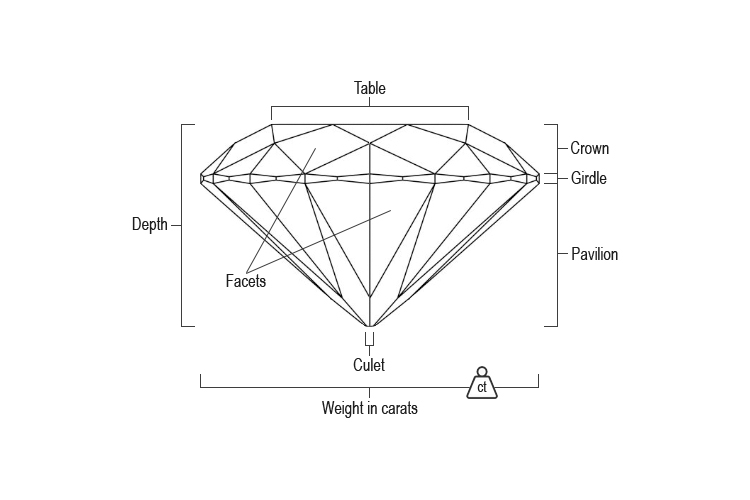
Diamonds are precisely cut to maximise their beauty and
brilliance. Although they may look straightforward, each diamond
is made up of different sections that work together to reflect and
refract light. From the flat top surface to the pointed base,
every part of the diamond’s structure affects how it handles light
and how bright it appears. We hope this diagram helps you to
better understand the complexity of diamonds.
The 4 C's of Diamonds
When choosing a diamond, it’s important to understand that no two
stones are ever exactly the same. Each diamond has its own balance
of characteristics that work together to determine its overall
beauty and value. The key is not simply to chase the highest
technical grades, but to find the right combination for your eye,
your design and your budget.
- Carat - the weight of a diamond. 1 carat is 0.2 grams.
Engagement or wedding rings may feature a single 0.05 ct to 0.5
ct diamond, or a cluster of smaller stones. Just a footnote -
you should not confuse the carat weight of diamonds with the
carat used for the purity of gold (e.g. 18ct gold).

- Colour - diamonds are graded from D to Z where D is completely
colourless (most prized and expensive), while Z has a yellow
hue. Most engagement rings use 'near colourless' stones,
typically graded G-H. The standard set by the Gemological
Institute of America (GIA) describes the grade ranges as
follows:

- Clarity - is a way to describe marks and flaws within a
diamond. Tiny "inclusions" are small pieces of black carbon or
other minerals located inside the diamond. External blemishes,
those on the surface of the stone, are also incorporated into
the clarity score of a diamond. Popular grades for engagement
rings are VS1, VS2 ('very slightly imperfect') and SI1, SI2
('slightly imperfect'). In these classifications, there are
imperfections but so tiny you can't see them with the naked eye.
Diamonds are formally graded according to the following scale:

- Cut - the shape and facet arrangement. The most usual cut is
the "modern brilliant" which has 58 facets to maximise the
diamond's sparkle. Other popular choices are princess (square)
cut and baguette (rectangular) cut. There are many other fancy
diamond shapes, so select the one that suits your style - see
the section below for further details.
The price of a diamond reflects all of these qualities and other
characteristics unique to the stone. With expert guidance, you can
select a diamond that feels exceptional to you - one that delivers
sparkle, presence and meaning in equal measure.
Rainbow Diamonds
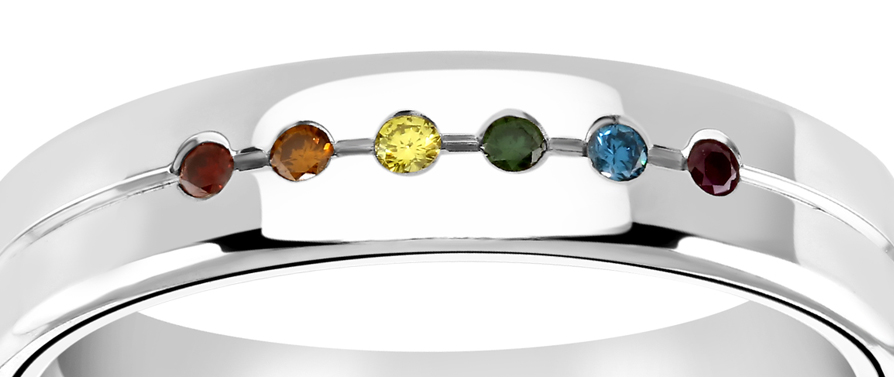
At WOOLTON & HEWITT, coloured diamonds are our specialty. We
source natural stones that are treated to create vibrant colours,
allowing us to set rings in the colours of the LGBTQ+ rainbow. Our
EMOTION
in DIAMONDS collection features iconic rainbow engagement
and wedding rings, a truly symbolic way to celebrate love,
diversity, and self-expression.
Lab-Grown Diamonds
The quality and availability of lab-grown diamonds has increased
dramatically in recent years. These are true diamonds, but created
in a laboratory rather than deep within the Earth.
- The process uses high temperature and pressure starting from a
tiny carbon seed to form a full-sized diamond suitable for
jewellery.
- Main benefit: more affordable than natural diamonds, without
compromising on beauty or durability.
We offer both natural and lab-grown diamonds, so you have the
freedom to choose the option that best suits your values and
budget.
Key Diamond Shapes
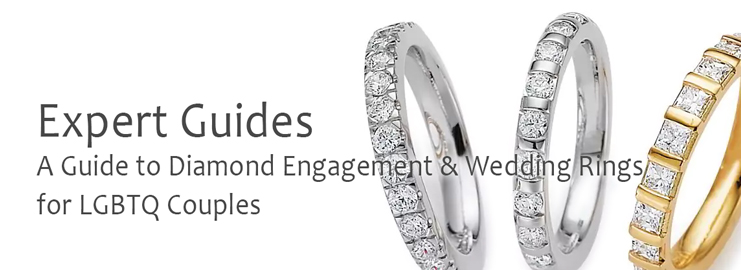
The cut of a diamond plays a crucial role in how it interacts with
light and how it ultimately appears in a ring. Each shape carries
its own character - from timeless and traditional to bold and
expressive - so the right choice depends on your personal style,
the setting design and the statement you wish your ring to make.
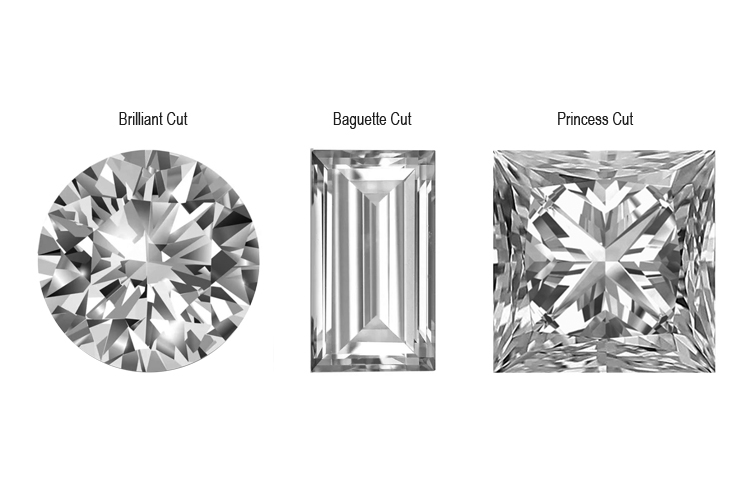
- Brilliant Cut - The most classic and widely chosen cut, its
round shape is engineered to maximise light return and sparkle
through its precise faceting - see
example design.
- Princess Cut - A contemporary square shape with sharp corners
and strong brilliance, offering a clean and modern look - see
example design.
- Baguette Cut - A slim, rectangular step-cut stone with
understated sparkle, often used for a sleek, minimalist
aesthetic - see
example design.
- Heart Shape - A romantic and symbolic cut that requires expert
craftsmanship to achieve perfect symmetry and maximum brilliance
- see
example design.
- Asscher Cut - A square step-cut design with cropped corners
and a distinctive 'hall of mirrors' effect, known for its
sophistication - see
our bespoke pieces.
- Marquise Cut - An elongated shape with pointed ends, designed
to create a graceful and dramatic silhouette - see
our bespoke pieces.
Beyond determining the shape of the stone, the quality of the cut
influences brilliance, fire and overall presence. To learn about
the anatomy of a brilliant cut diamond click
here.
Conflict-Free Diamonds and Sustainability
We believe diamonds should be something to celebrate. That’s why
we work with partners who share our commitment to responsible
sourcing and ethical business practices.
We aim to ensure the diamonds used in our wedding jewellery come
from legitimate sources and are traded through transparent supply
chains. Industry initiatives such as the Kimberley Process
Certification Scheme help prevent the trade of conflict diamonds.
All of our suppliers comply with the Code of Practices of the
Responsible Jewellery Council, thus ensuring that the diamonds we
use meet these international standards.
Responsible diamond sourcing includes:
- Conflict-free sourcing aligned with the Kimberley Process
Certification Scheme
- Transparency and traceability in the diamond supply chain
- Respect for human rights in mining, cutting and trading
- Prevention of child labour and forced labour
- Safe working conditions in diamond cutting and polishing
- Environmental responsibility in diamond mining
We expect all companies in the supply chain to respect human
rights, avoid child or forced labour, and operate in ways that
minimise environmental impact. By choosing responsible suppliers
we aim to ensure that the jewellery we create is produced in ways
that respect people, communities and the environment.
Written by Paul - Founder
of WOOLTON & HEWITT and LGBTQ+ wedding jewellery specialist
Reviewed by the WOOLTON & HEWITT workshop and design teams








 Fine
Quality - beautifully made rings
Fine
Quality - beautifully made rings Expert Advice - chat things over with us
 Warranty - workmanship guaranteed
 Delivery - fast and insured
 Types
of precious metal
Types
of precious metal